







Journal · 10 min read
Back Pain Going Down Your Leg? Could It Be Sciatica?

Dr. Priya Trivedi
21 October 2026
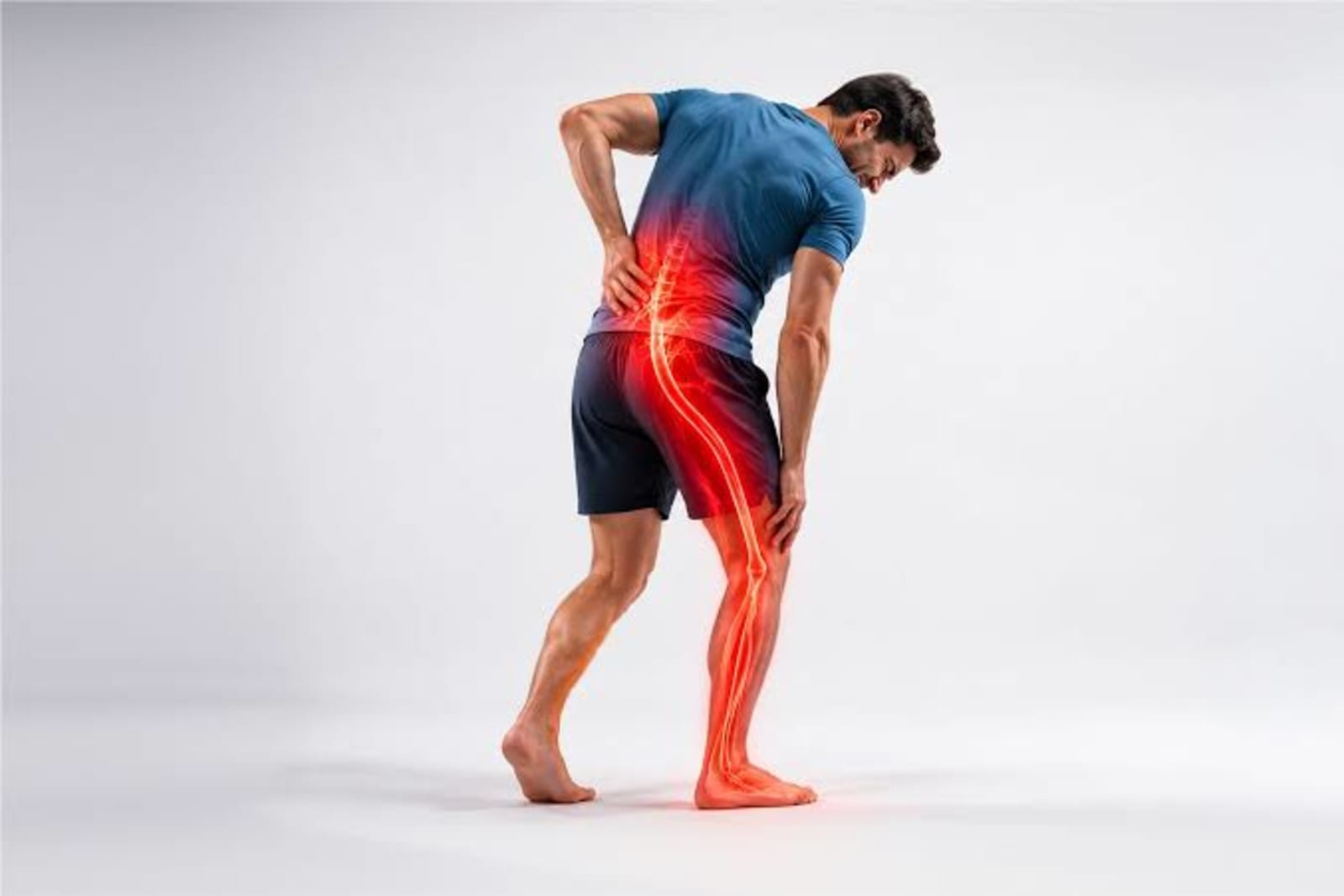
Does your lower back pain travel into your buttock, thigh, calf or foot?
Perhaps you also notice tingling, pins and needles, numbness or weakness in one leg.
These symptoms are often described as “sciatica.”
Sciatica happens when the sciatic nerve or the nerve roots that contribute to it become irritated or compressed. Symptoms commonly affect the buttock and the back of one leg and may include sharp or burning pain, tingling, numbness or weakness.
However, not every pain travelling into the leg is automatically sciatica.
The pattern of symptoms, neurological findings, movement and medical history all matter.
If your back or leg pain keeps returning, affects walking, sitting or working, or is accompanied by tingling or numbness, an individual assessment can help determine what may be contributing.
At O2Revive, Hinjawadi:
We Assess First. We Recommend Only What You Need.
What Is Sciatica?
Sciatica describes a group of symptoms associated with irritation or compression affecting the sciatic nerve pathway.
The sciatic nerve runs from the lower back through the buttock and down the leg.
Typical symptoms may include:
Pain travelling from the lower back or buttock into one leg
Burning or sharp pain
Pins and needles
Tingling
Numbness
Weakness in some cases
Symptoms that may change with certain movements, coughing or sneezing
You may have lower back pain as well, although for some people the leg symptoms are more noticeable than the back pain.
If you have only lower back pain without symptoms travelling into the leg, that does not necessarily mean you have sciatica.
Why Does Sciatica Happen?
There can be different reasons for nerve irritation.
Changes involving structures in the lower spine can sometimes irritate or compress a nerve root.
But simply knowing that someone has leg pain is not enough to identify the exact cause.
A physiotherapy assessment therefore looks at the complete symptom pattern.
Questions may include:
Where does the pain start?
How far down the leg does it travel?
Is there numbness or tingling?
Do you feel weakness?
What movements change your symptoms?
Did the problem begin suddenly or gradually?
These details can provide important clinical information.
Is Pain Down the Leg Always Sciatica?
No.
Pain can travel into the buttock or leg for several reasons.
Some symptoms may come from structures around the lower back or hip without significant nerve involvement.
That is why self-diagnosing based on a pain diagram from the internet may be misleading.
For example, someone may describe:
Pain from the back into the buttock
while another person experiences:
Burning pain from the buttock all the way into the foot with numbness
These may require different clinical considerations.
An assessment helps determine whether the symptoms behave like nerve-related pain or whether another explanation should be considered.
Can Long Sitting Make Sciatica Feel Worse?
For some people, sitting for extended periods may aggravate their symptoms.
This can be particularly noticeable during:
Long laptop sessions
Back-to-back meetings
Driving
Long commutes
Flights
Working from a sofa or bed
For a professional working in Hinjawadi, a day might involve several hours at a laptop followed by a long commute home.
If symptoms repeatedly increase during sitting, the response should not automatically be to avoid sitting completely.
Instead, it may be useful to identify:
How long you can comfortably sit
Which positions affect symptoms
Whether changing position helps
Whether walking changes the symptoms
Which movements aggravate or relieve the leg pain
This information can be useful during assessment.
Should You Rest if You Have Sciatica?
Complete prolonged rest is not generally the goal for uncomplicated sciatica.
NICE guidance recommends providing advice tailored to the person and encouraging continuation of normal activities where possible. Exercise may also form part of management according to individual needs and capabilities.
That does not mean pushing through severe symptoms.
Activity may need to be adjusted temporarily.
For example, you may need to modify:
Gym exercises
Running
Heavy lifting
Long periods of sitting
Repeated bending
Activities that strongly aggravate symptoms
The appropriate level of activity differs between individuals.
When Should You See a Physiotherapist for Back and Leg Pain?
A physiotherapy assessment may be useful when:
Pain travels from your lower back or buttock into the leg
Symptoms keep returning
Sitting becomes increasingly uncomfortable
Walking is affected
You experience recurring tingling or pins and needles
Your normal exercise routine is limited
Pain affects sleep
Symptoms repeatedly return after temporary improvement
You are unsure which exercises are appropriate
You have previously had back pain and the symptoms have changed
Assessment becomes particularly important when neurological symptoms such as numbness or weakness are present.
What Does a Physiotherapy Assessment for Sciatica Look At?
A physiotherapist may assess much more than the location of your pain.
Your Symptom Pattern
You may be asked:
Where does the pain begin?
Where does it travel?
How long have you had it?
Is the pain constant or intermittent?
Do you experience tingling?
Is there numbness?
Have you noticed weakness?
What activities make symptoms worse?
What makes them better?
The distribution of symptoms can help guide further assessment.
Lower Back Movement
Your physiotherapist may examine how your symptoms respond when you:
Bend forward
Lean backward
Move sideways
Walk
Sit
Change position
In some cases, movements may change where the symptoms are felt.
Neurological Assessment
When nerve involvement is suspected, the assessment may include checks of:
Muscle strength
Sensation
Reflexes
Nerve-related movement responses
These findings can help determine whether further medical assessment may be appropriate.
Your Daily Routine
For a working professional, an assessment may also consider:
Sitting duration
Commute
Laptop use
Work-from-home setup
Gym training
Lifting
Running or sport
Sleep
Previous back problems
Symptoms often make more sense when viewed in the context of your full day.
Do You Need an MRI for Sciatica?
Not automatically.
It is common to assume that leg pain means you immediately need an MRI.
However, NICE advises against routinely offering imaging in a non-specialist setting for people with lower back pain with or without sciatica.
Imaging may be considered in specialist care when the result is likely to change management.
This means the clinical assessment remains important.
A scan is a tool.
It is not a substitute for understanding your symptoms, movement and neurological findings.
What Might Physiotherapy for Sciatica Include?
There is no single “sciatica exercise” that is suitable for everyone.
Depending on the assessment, physiotherapy may involve:
Education about your symptoms
Advice about remaining appropriately active
Individualised exercises
Movement-based rehabilitation
Progressive strengthening
Activity modification
Guidance for sitting and work
Gradual return to gym or sport
Manual therapy where appropriate
Home exercises
Progress reviews
NICE recommends that manual therapy, when used for lower back pain with or without sciatica, should form part of a broader treatment package that includes exercise rather than being used as the only treatment.
At O2Revive, this fits naturally with an assessment-first approach.
The question is not:
“Which treatment is used for sciatica?”
It is:
“What does this particular person need based on their assessment?”
Should You Do Sciatica Exercises From YouTube?
Online exercise videos can provide general information.
But “sciatica” describes a symptom pattern rather than one identical problem in every person.
One movement may feel helpful for one person and significantly aggravate symptoms for another.
This is particularly relevant when there is:
Significant leg pain
Numbness
Tingling
Weakness
Rapidly changing symptoms
If an exercise repeatedly increases pain further down the leg or causes new neurological symptoms, simply continuing because it was labelled a “sciatica exercise” may not be sensible.
Assessment can help determine what type and level of movement is appropriate.
Why Does Sciatica Sometimes Keep Coming Back?
A common pattern is:
Pain starts → activity reduces → symptoms improve → normal activity resumes suddenly → symptoms return
This does not necessarily mean that the back is permanently damaged.
Sometimes rehabilitation needs to build enough tolerance for the activities you want to resume.
For one person that might mean sitting comfortably through a workday.
For another it might mean returning to the gym.
For someone else it could mean running, badminton or lifting.
The goal of rehabilitation should therefore extend beyond simply waiting for symptoms to disappear.
Sciatica and the Hinjawadi Workday
For many Hinjawadi professionals, a typical day may involve:
Long commute → laptop work → meetings → prolonged sitting → commute home
If back and leg symptoms are already sensitive to sitting, this routine can make working difficult.
The solution is not necessarily to stop sitting altogether.
Instead, assessment may help identify:
Your current sitting tolerance
Useful movement breaks
Activities that aggravate symptoms
Movements that may help
Strength or capacity that needs rebuilding
Whether further medical investigation is required
If you are searching for sciatica physiotherapy in Hinjawadi, the first priority should be understanding your symptoms rather than starting a standard treatment package.
The O2Revive Approach to Sciatica Physiotherapy
At O2Revive, treatment begins with assessment.
We follow THE O2REVIVE METHOD:
ASSESS
Understand your back and leg symptoms, neurological signs, movement, lifestyle and goals.
PERSONALISE
Create a plan based on what the assessment identifies.
TREAT
Use appropriate physiotherapy and rehabilitation strategies according to your needs.
REVIEW
Track your symptoms, function and progress and adjust the plan when needed.
Someone with mild intermittent leg symptoms may require a very different approach from someone experiencing persistent numbness or weakness.
That is why we assess first.
When Sciatica Symptoms Need Urgent Medical Attention
Most sciatica is not a medical emergency.
However, some symptoms can indicate serious nerve compression and require immediate medical assessment.
Seek emergency medical care if you develop:
Sciatica affecting both sides
Severe or worsening weakness or numbness in both legs
Numbness around the genitals or anus
New difficulty starting urination
Inability to urinate
New loss of bladder control
New loss of bowel control
These symptoms can be associated with a serious condition called cauda equina syndrome and require urgent hospital assessment.
Frequently Asked Questions
What does sciatica pain feel like?
Sciatica may cause sharp, burning or shooting pain travelling through the buttock and down one leg. Tingling, numbness or weakness may also occur.
Can you have sciatica without back pain?
Yes. Some people experience more significant leg symptoms than lower back pain.
Is every pain going down the leg sciatica?
No. Several conditions can cause pain around the buttock or leg. An assessment can help determine whether your symptoms appear consistent with nerve-related pain.
Can physiotherapy help sciatica?
Depending on the individual, physiotherapy may include education, appropriate activity, exercise, progressive strengthening and other rehabilitation strategies.
Should I keep walking with sciatica?
Remaining appropriately active is generally encouraged for many people with uncomplicated sciatica. However, activity should be adjusted to your symptoms and clinical situation.
Do I need an MRI for sciatica?
Not necessarily. Imaging is not routinely required for every episode of sciatica. It may be considered when the result is likely to change management or when particular clinical findings require further investigation.
How long does sciatica take to improve?
Recovery varies considerably between individuals. The cause, severity, neurological symptoms, activity demands and response to management can all influence progress. A fixed recovery timeline should not be assumed.
Back Pain Travelling Down Your Leg? Assess It First
Pain travelling from your lower back into the leg deserves more than a generic list of stretches.
The important questions are:
Where are the symptoms travelling?
Is there tingling, numbness or weakness?
What movements change the symptoms?
How are your daily activities affected?
Does anything suggest further medical investigation is needed?
At O2Revive, Hinjawadi:
We Assess First. We Recommend Only What You Need.
Move Better. Feel Better. Revive.
BOOK AN ASSESSMENT
WHATSAPP US
Already undergoing treatment but your back or leg pain keeps returning?
BOOK A FRESH ASSESSMENT
This article provides general educational information and does not replace an individual medical or physiotherapy assessment.

About the author
“A patient who does the right movement ten times a day beats a patient who comes to the clinic three times a week and does nothing in between. Every time.”
Dr. Priya Trivedi
Founder & Clinical Director
Seventeen years and more than three and a half thousand patients have taught me one thing: people do not want to be sold a treatment. They want to be understood, told the truth about what is possible, and then treated properly. O2 Revive grew out of that — I built it so a patient recovering from a knee replacement and a client planning her brows could walk into the same calm room and both be looked after by someone qualified to decide what they actually need.
- 17+
- Years in practice
- 11000+
- Patients treated


Not sure which treatment you need?
Book a consultation. We will assess, explain your options honestly, and quote before anything starts.